Human Powered
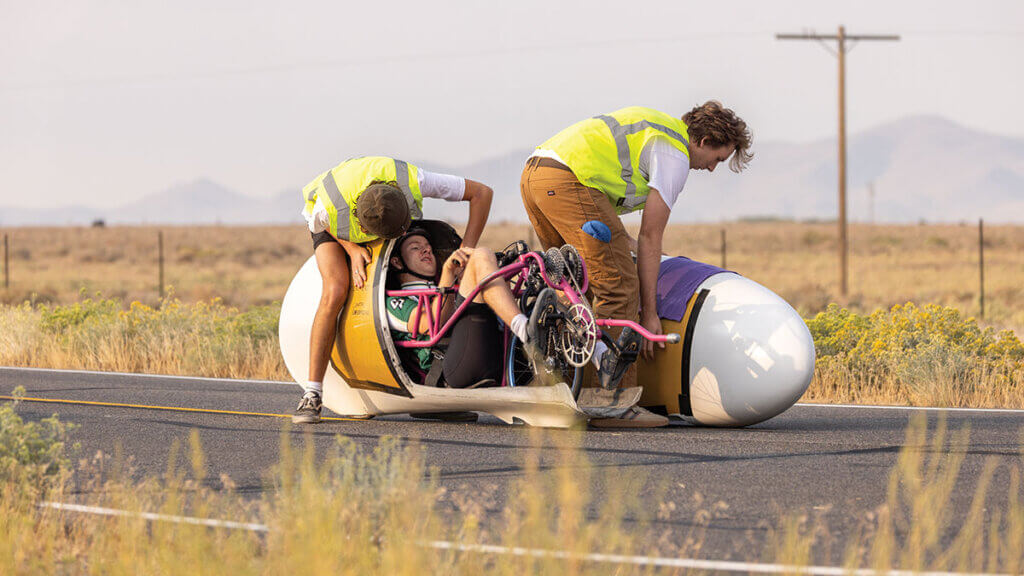

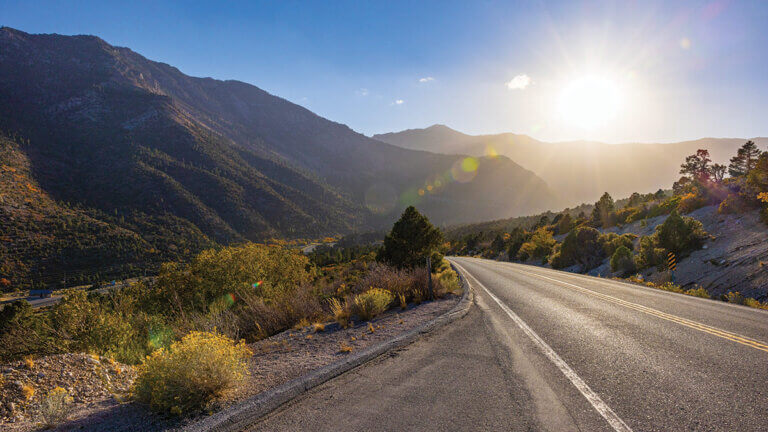
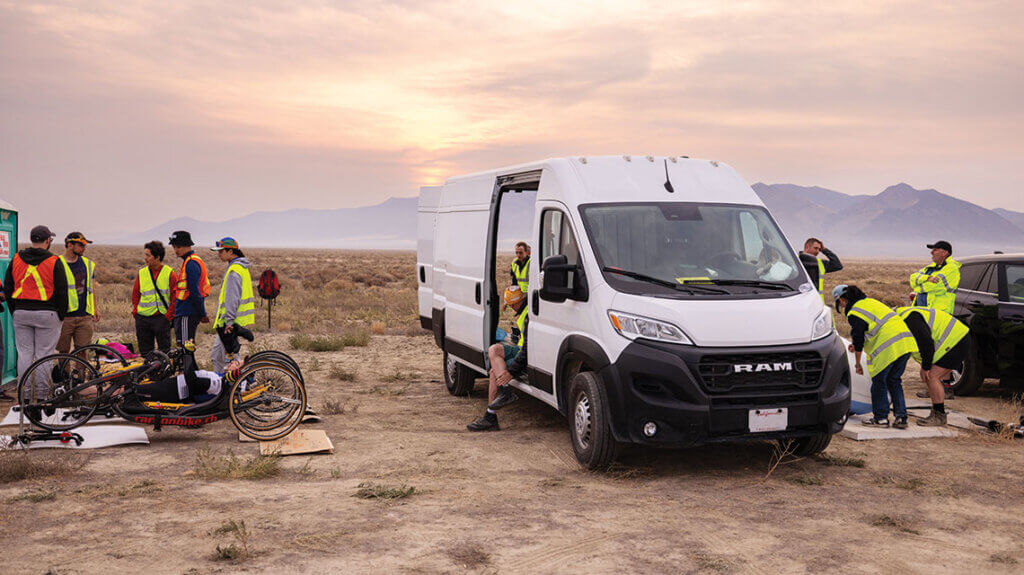
It’s early morning in late summer, and we’re parked off a remote highway in northern Nevada. The sky is hazy, and the sun rises a deep red. This is as ordinary a spot you’ll find within a 200-mile radius: a narrow sagebrush valley surrounding a long ribbon of pavement. But it’s not an ordinary scene, and this is not just any road. For many, it’s the best highway in the world.
For 23 of the past 25 years, this 5-mile stretch of Nevada State Route 305 near Battle Mountain has been home to the World Human Powered Speed Challenge (WHPSC)—one of the most unique and specialized events in the state.
Athletes, tinkerers, and cyclists arrive from around the world to participate in the weekslong competition. All are here to answer one question: What’s the fastest achievable speed on muscle power alone?
While the event hosts many race categories (multi-rider, bikes, trikes, and even hand-powered vehicles), there is one record that tantalizes above all others. It’s the record: the maximum speed ever achieved by human power. For those arriving at the 2025 WHPSC, that sat at 89.59 mph—set by Todd Reichert in 2016 (Ilona Peltier set the women’s record of 78.61 mph in 2019). And yes, those records were set here.
On Your Mark
First heats aren’t until 7 a.m., but we need to arrive early. The racetrack is on a state highway that sees its fair share of traffic, so coordinators can only close the road for 20-minute intervals. If we miss our window, we’ll be stuck behind a road flagger.
The 5-mile course is split into three sections: finish line, 2.5-mile launch, and 5-mile launch. Beyond the finish line is an area called “catch,” where the bikes are intercepted by volunteers before the deceleration topples them.
Our day starts at the 2.5-mile launch. While the pros launch at the 5-mile, this halfway point is where teams qualify.
In the early morning chill, teams move with practiced precision as they unload their sleek, hyper-modern rigs. Apart from us—and a U.K. camera crew—everyone else is either a coordinator, a racer, or a team member.

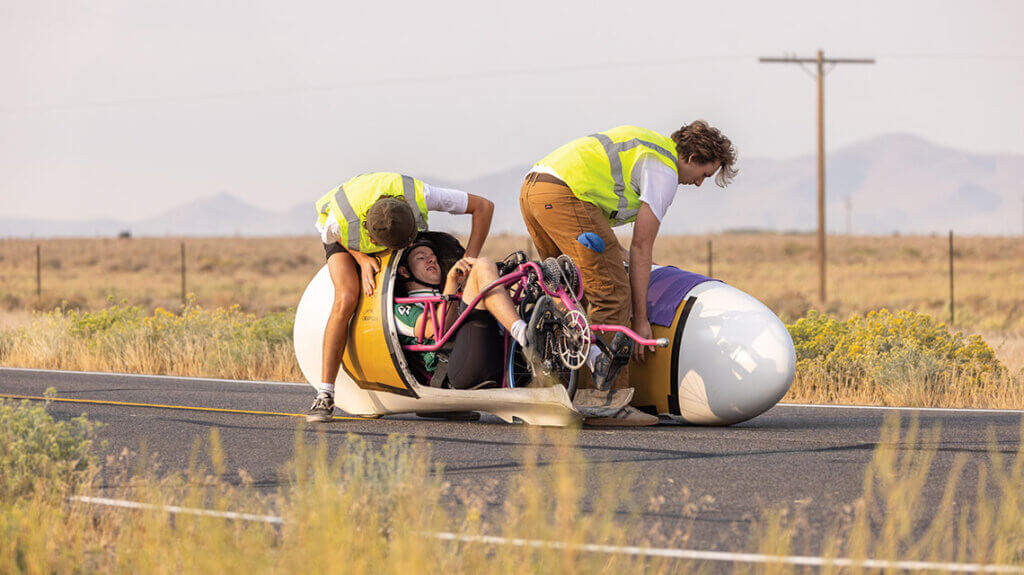
Light finally floods the valley, and the launch area comes alive with nerves, excited chatter, and plenty of technical jargon. Teams start their pre-launch checklist, adding air to tires, making minor repairs, and testing electrical connections. Nearby, athletes warm up with lunges or a short jog along the cattle fence.
There are many teams here, but there is also a strong sense of friendship among participants. After all, this is as much a reunion as it is a competition.
“We are all family,” says one attendee. “At the end of the day, we’re all collectively hoping someone breaks 90 mph.”
The camaraderie is enhanced by the fact that this is rural Nevada, where extra help and spare parts for specialized bikes are a luxury. Everyone shares, volunteers time, or fills in where needed—even if that means jumping into another team.
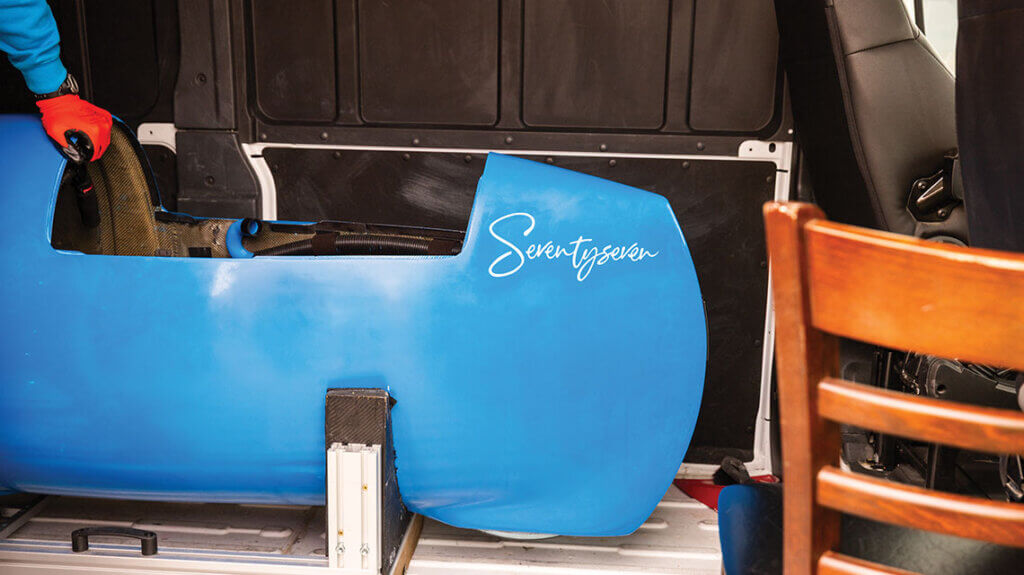
That was the case when we met Barney, an effervescent cycling guru from the U.K. team. He’s here this morning to assist a Dutch racer who found himself without helpers. As we chat, Barney shows off his team vehicle, a sleek blue machine named Seventyseven.
“The athlete inside has a hard job,” says Barney. “They’re in a vehicle designed for their body with only a few millimeters of clearance.”

On The Road
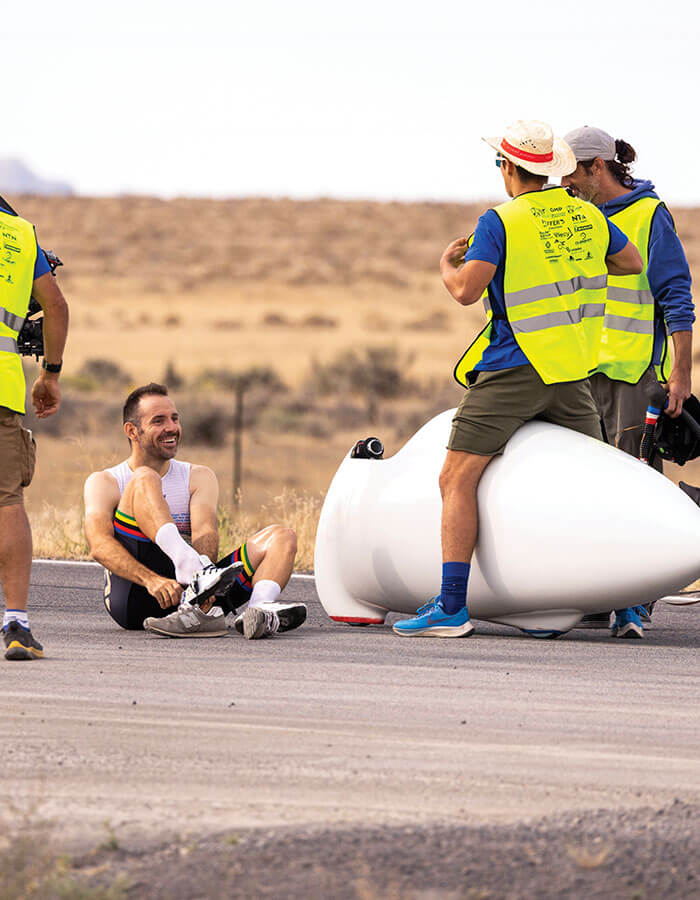
According to everyone involved with this event, Nevada State Route 305 is one of the best places in the world to set speed records.
“There’s nothing like this road anywhere,” Barney tells us. “It’s flat, it’s straight, it’s long, and it’s at around 5,000 feet elevation.”
Study S.R. 305 on a satellite map, and you’ll see just how perfectly plumb this section is. And while it’s hardly the only straight road around, the elevation puts it into a league of its own.
Altitude is important: Too high, athletes get less oxygen. Too low, they’re practically swimming through air. Beyond being just right for record setting, the elevation here also contributes to the area’s mild climate, which is important. Calm, predictable weather is critical in these competitions. For a record to be legal, wind speeds must not exceed 3.71 mph. That is barely more than a breeze. And it’s why the event is in early September. Historically, that’s been the calmest, most storm-free time of the year.
The World Human Powered Speed Challenge isn’t the only event in the human-powered vehicle circuit: There are races and competitions held year-round and across the world. But this is the big one; it’s the event people attend to set world records.
And today might be that day.
We finish the qualifying heats from the 2.5-mile launch, and the road reopens. As semi-trucks pass by, the convoy prepares to move up the road to the 5-mile area, fondly referred to as the big boys. People are excited about what might happen there. Everyone’s talking about the French team and its star rider François. I’m told that if anyone is going to break the world record this week, it’s them.
As soon as we show up, it’s clear this is the big leagues. Things feel more professional and focused—also more serious. In the back of the Dutch and French team vans, athletes warm up on large stationary bikes.
When the road closes again, conditions are perfect: zero range downwind, 63 degrees. François steps out of the van, ready for his run. Everyone watches as the Frenchman walks to his bike. Again, we hear whispers that this could be a world record moment. He climbs into his sleek machine and has a successful launch.
But if there is a world record, we won’t know for another hour. They’ll announce times at the morning briefing back in town.
Time to Shine
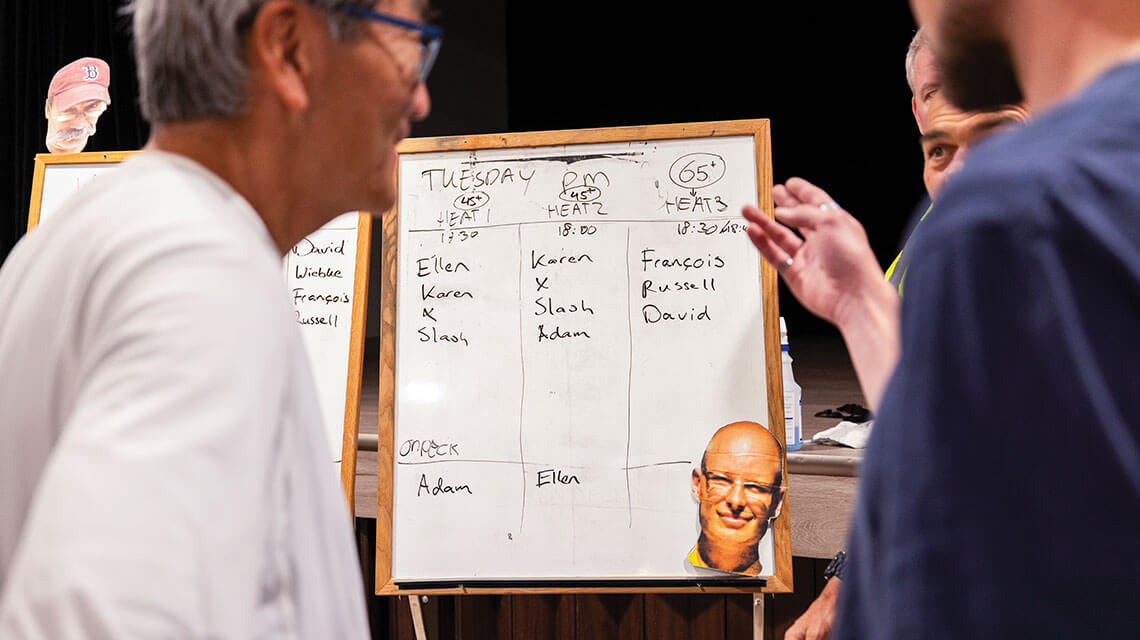
By 10:30 a.m., the morning heats are over, and everyone returns to Battle Mountain. The next round of races won’t start until this evening (when the wind is more calm).
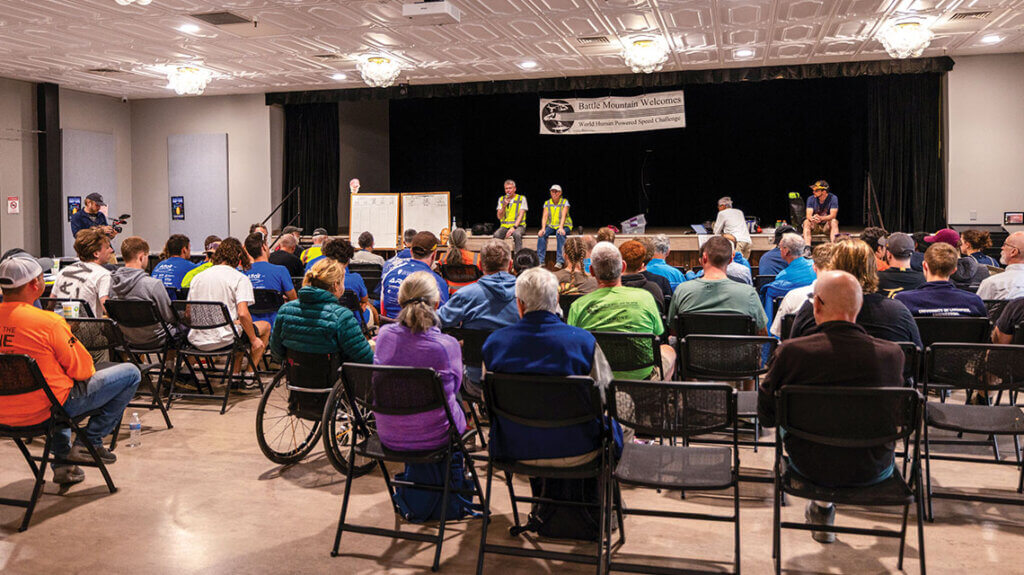
At the community center—and race headquarters—people eat breakfast and discuss the morning’s drama. Eventually, everyone gathers in the auditorium for the briefing, where organizers give a weather report and announce the official times.
Unfortunately, no one set a record that morning. François clocked 85.84 mph. Blazingly fast, but nowhere near the logarithmically scaling challenge of crossing 89.54 mph. (As a consolation prize, later in the week he did achieve 88.07, the fastest time ever for a European.)
After announcing time slots for the evening’s races, the briefing turns to an important matter (which is the reason we chose today for our visit). That afternoon, the convention hall will come alive as racers host a beloved, community event: the Show and Shine.
I grew up in rural Nevada. There are nice things about growing up in the country, but childhood experiences like this are rare. But here we were, watching kids from a mining town—small even by Nevada standards—face-to-face with some of the most high-tech analog bicycles on the planet. I don’t think that’s something they’ll ever forget.
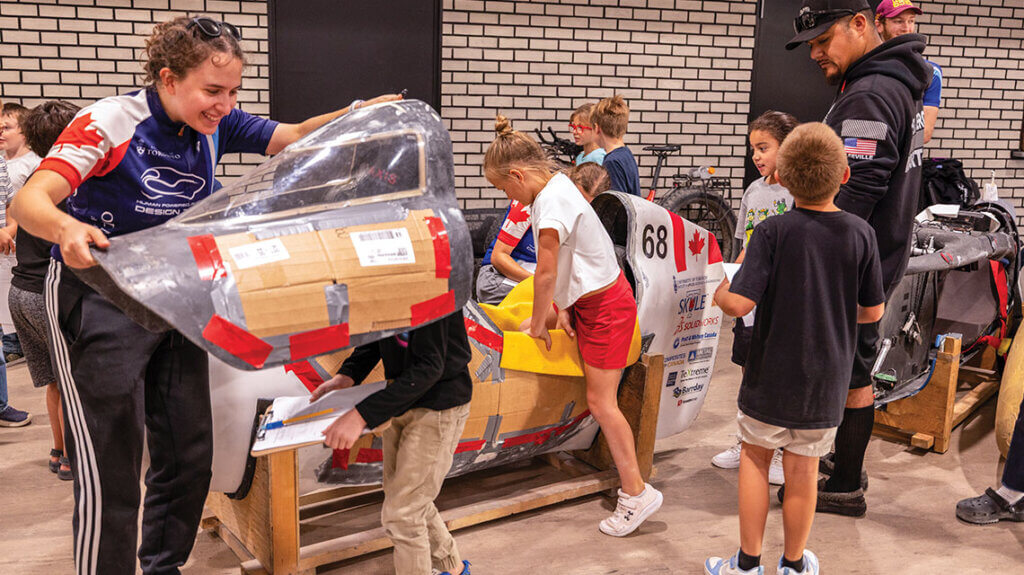
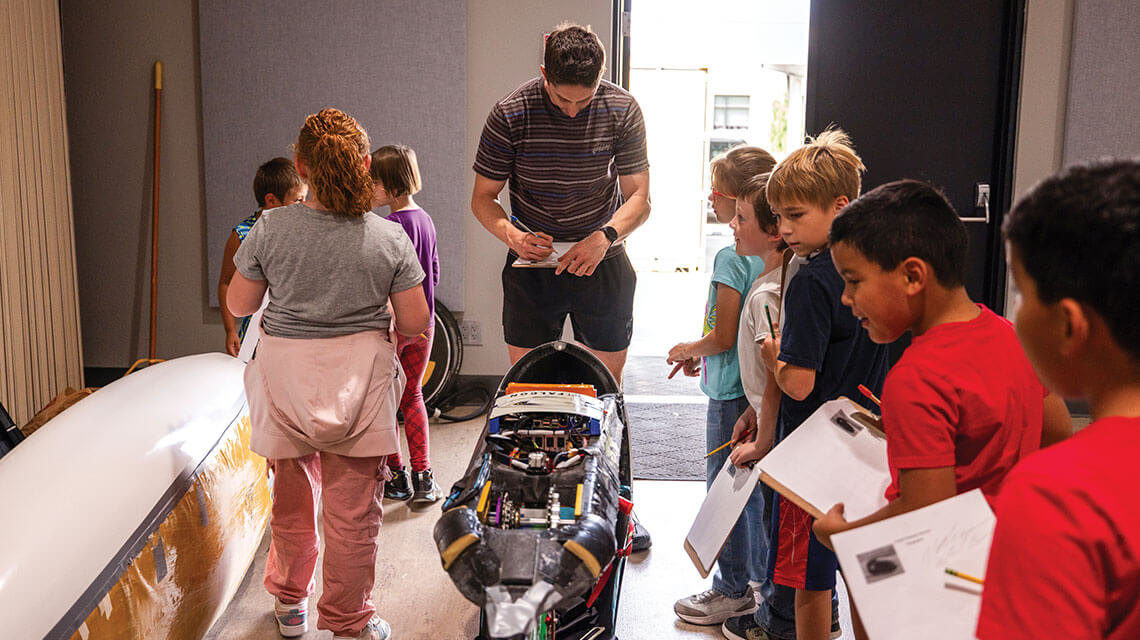
At 1:30 p.m. sharp, dozens of third graders burst into the race headquarters accompanied by lively harmonica. With papers clutched in hand—where they hope to gather as many racer autographs as possible—the students excitedly visit the buffed and polished vehicles. Teams stand by to lift kids into cockpits, let them pedal to their heart’s content, and field dozens of breathless questions like “how fast does this one go?” and “why aren’t there windows?”—as I watch, it strikes me that those were the same questions I’d asked that morning.
As I watch, I also think about the other thing participants have told us during our short visit. There’s a chance this is the last crop of students to see any of this. That’s because the future is very uncertain for the World Human Powered Speed Challenge. From what I understand, this might be the last one.
Bumpy Road Ahead
Battle Mountain treasures and supports the World Human Powered Speed Challenge. It makes sense: This is easily its largest tourism event. For one whole week, dozens of out-of-towners intensely invest in the community, filling up pretty much every hotel, eating at restaurants, and visiting grocery and hardware stores hourly.
The trouble comes from the very feature that makes this event possible in the first place. To put it bluntly, the road’s condition is no longer of a quality that can set records.
In 2009, organizers secured a federal grant to pave their portion of highway. Afterwards, the event saw a surge in participation—not to mention a new world record. But a decade of heavy vehicles, icy winters, and runoff have degraded the road below the point where people can set records.
Attending the WHPSC takes significant investment. Most of these teams are international, and bringing a crew and a giant road bike to the middle of Nevada is expensive and takes planning. If they don’t believe setting records is possible, they’re not going to attend. Many teams have already signaled they might pull out unless the road gets repaired.
Attempts by organizers to secure funding or support for repavement have so far proved unsuccessful. The future for one of Nevada’s most unique sporting events remains uncertain.